


I have a friend who is a successful local filmmaker. His latest feature is currently being prepped for nationwide release in the country of its production, which is our shared home of Singapore. He is a double threat being a writer AND director, and is a dab hand at both. Because of his skills he has been approached to write and direct a fully funded 5-part series using AI, as something of a showcase for what’s possible in the field of audiovisual production. It would be more than fair to say this has vexed him and so he reached out to me to challenge his thinking and see if we could come to a conclusion as to whether or not it is ethically okay to make an AI film. But first a rather large and inconvenient caveat...

AI’s Original Sin
Original sin, for those that never went to Sunday school, defines the state of human nature inherited from Adam and Eve’s disobedience in the Garden of Eden. It signifies that all people are born with a corrupted nature inclined toward sin and are separated from God, rather than being born innocent. It is a state of being, not an individual act.
AI, like humans, carries original sin in the core of its GPUs, born of the fact that it was trained on stolen, copyrighted works for which no one received any compensation. This is a given. It has happened. My friend was not responsible for that and though reparations may one day be made, the original sin cannot be undone nor the genie put back in the bottle. So, for the purposes of this discussion, we must put that aside and focus on the other ethical factors at play.
What’s the right amount of AI?
Most of the discussions around AI in any field right now are too broad because it is an all-purpose technology, like the Internet or electricity. What we must first do is hone in on the specific tasks AI could be applied to in the process of making an audio-visual product:
AI for research
AI for conceptualisation
AI for screenwriting
AI for storyboarding
AI for production design
AI for production planning
AI for performances
AI for locations & sets
AI for editing
AI for special effects
Which of these is a legitimate use of AI? How much of the production has to use AI for it to be considered an AI production? What are the mitigating factors from both a creative and financial perspective?
For my filmmaker friend, conceptualising, writing and even storyboarding is a non-negotiable, that’s what he got into this game for, to express his artistic vision through words, not have someone or something else do it for him. However, this already slows the process, increases the cost and undermines the experiment the producer is attempting to undertake, for the producer is trying to prove how much quicker and cheaper AI filmmaking could be. If a film is written by a human, does it still count as an AI film?
What do other people bring to the table?
The early stages of a film i.e. research, conceptualisation and writing are often embarked upon as a solo adventure but, typically, once the process of visualisation gets underway other talented individuals with different skills, tastes and experiences are brought in to bring the words to life. This is, traditionally, a collaborative process wherein the writer is introduced to worlds more fantastic or authentic or detailed than he or she ever imagined by a director, storyboard artist, production designer and/or director of photography. The idea is that, by adding their deep expertise and unique perspective into the mix, the team are able to create something greater than the sum of its parts.
Now, thanks to the magic of AI, an individual can accomplish all of this alone, but why? Will it make for a better product? Unlikely, seeing as the writer works with words not images and so would have to rely on the AI to bring the vision, which it would be compiling from an archive of every scene ever captured - good, bad and ugly. The result is often the average of all the shots it drew from and no one sets out to make an average film.
And what about the experience? Film production has, traditionally, been a team sport, which spreads the burden of the output across multiple team members and, let’s not forget, makes it fun! Why should every process in the age of AI come down to an individual labouring alone at their keyboard?

Where might we actually want AI’s help?
Production planning i.e. breaking down of the script into scenes and shots and schedules and prop lists and costume changes should be exactly the kind of tedious, administrative task that AI excels at and yet it doesn’t. Here’s the experience of Dayne Cowan, CEO of Kraken Kollective and former Head of Post Production for Amazon MGM Studios in Southeast Asia:
I fed a script into ChatGPT, requesting it to create a breakdown of all the likely VFX required. Converting this into a spreadsheet is a deeply time consuming and nuanced task that usually takes a person at least a week to put together. It’s a complex blend of knowing what can be achieved practically using sets and locations, miniatures, set design and costumes versus the myriad of ways VFX can be applied to move visual challenges. There is then a refining process that balances the cost of each approach, arriving at a final workable VFX requirement to suit the budget. It’s laborious task that feels like something AI should be able to analyze and at least give you a solid starting point for.
When I loaded the script and entered a very detailed prompt specifying exactly what was likely to be done with VFX, and what would be practical, it replied with all the right industry language: ‘Would you like this sort of information extracted, with these columns, in this sort of sheet? All of the right questions an experienced VFX coordinator might ask so I confidently awaited the VFX breakdown, feeling amazed and impressed that this often tedious task could be done in minutes.
Unfortunately the sheet I got back was mostly blank with not a single bit of useful, usable information in its analysis. I re-prompted it several times. Predictably, it apologized, said it now understood what I was after - then gave back exactly the same blank sheet of paper as before. I gave up. If it was a human employee I would have fired them on the spot!
Contrary to what the tech CEOs are trying to sell us, AI wants to make the pretty things whilst leaving the drudgery to us meat puppets. But it also wants to make the pretty things too pretty, as Indian Filmmaker Arindam Dey explained to me:
“Any art form or piece of art can not be completed without imperfections. Imperfection is the most artistic sign of a complete art, because imperfection, how little it may be, portrays the human touch . And AI can not be imperfect. Even if you generate imperfection through AI, it will look like perfectly created imperfection.”
Is acting just a process?
Remember Tilly Norwood, the first “AI actor” with an agent? What a joke that was and yet AI influencers are blowing up on Instagram and TikTok so should an AI film use AI actors? It depends what you think an actor does. If they are merely there to look pretty, say lines that move the story forward and promote it to their online fanbase then, sure, cast an ethnically ambiguous yet conventionally attractive ‘AInfluencer’ and hope the audience cares what happens to their pixels.
However, if you think actors bring a combination of talent, training, experience, emotion, charm, charisma and mystique that not only drives audiences to watch but also makes them stay by creating compelling characters that we actually care about. If you think that they interpret the script in ways that are both unexpected yet satisfying (think of Christopher Walken’s speech cadence, Al Pacino’s explosive outbursts, Daniel Day Lewis’ theatrics, Claire Danes’ fragility or Helena Bonham Carter’s otherworldyness)? If you think that a dead-eyed robot could hold my 11 year old in thrall for over 2.5 hours the way Ryan Gosling just did in Project Hail Mary? Then you’re kidding yourself. Actors remain the biggest driver of audiences and characters the driver of empathy and narrative - but is it unethical not to use them?
That depends whether you believe a profit-making enterprise owes actors, or anyone, a job. The fact that all AI owes a debt to the originators of each craft it automates is a given but if, for the purposes of this thought experiment, we must put that aside then I think, no, it is not unethical to use AI instead of actors. And I say that as a working actor who hasn’t had a voice over job in three years due to AI!
We replace people with automation all the time; think of all the knocker-uppers who were replaced by alarm clocks, the navvies replaced by JCBs and the baristas threated by Nespresso! The video game industry is bigger than the music and movie industry combined - they’ve been using computer generated characters for years and I don’t hear anyone complaining. The bigger question is, will an audience actually want to watch a show made with AI actors? Unlike video games, movies are a passive audience experience, which means the character has to work much harder to engage the viewer emotionally and intellectually. In video games the characters, played by the gamer, can actually die which creates real jeopardy and deep engagement. Can an AI actor do the same? I’d say no, but I have cried at more Pixar moves than I can count so I can’t be sure.
Do sets need to be real?
Singapore is so small that no part of it looks different to any other part. You simply cannot achieve a diversity of landscape within 287.4 square miles. We are also the densest nation on earth, which means interiors are small and everywhere is crowded. We certainly don’t have room for Hollywood-style soundstages and no one here is shutting down a street for your little art film project when there’s actual money to be made! If you want to shoot anything that isn’t an HDB, a hawker centre or a skyscraper you’re going to need to do it virtually. The country now has three volumetric stages that use Unreal Engine to create AI generated environments that actors can actually perform in front of and be surrounded by.
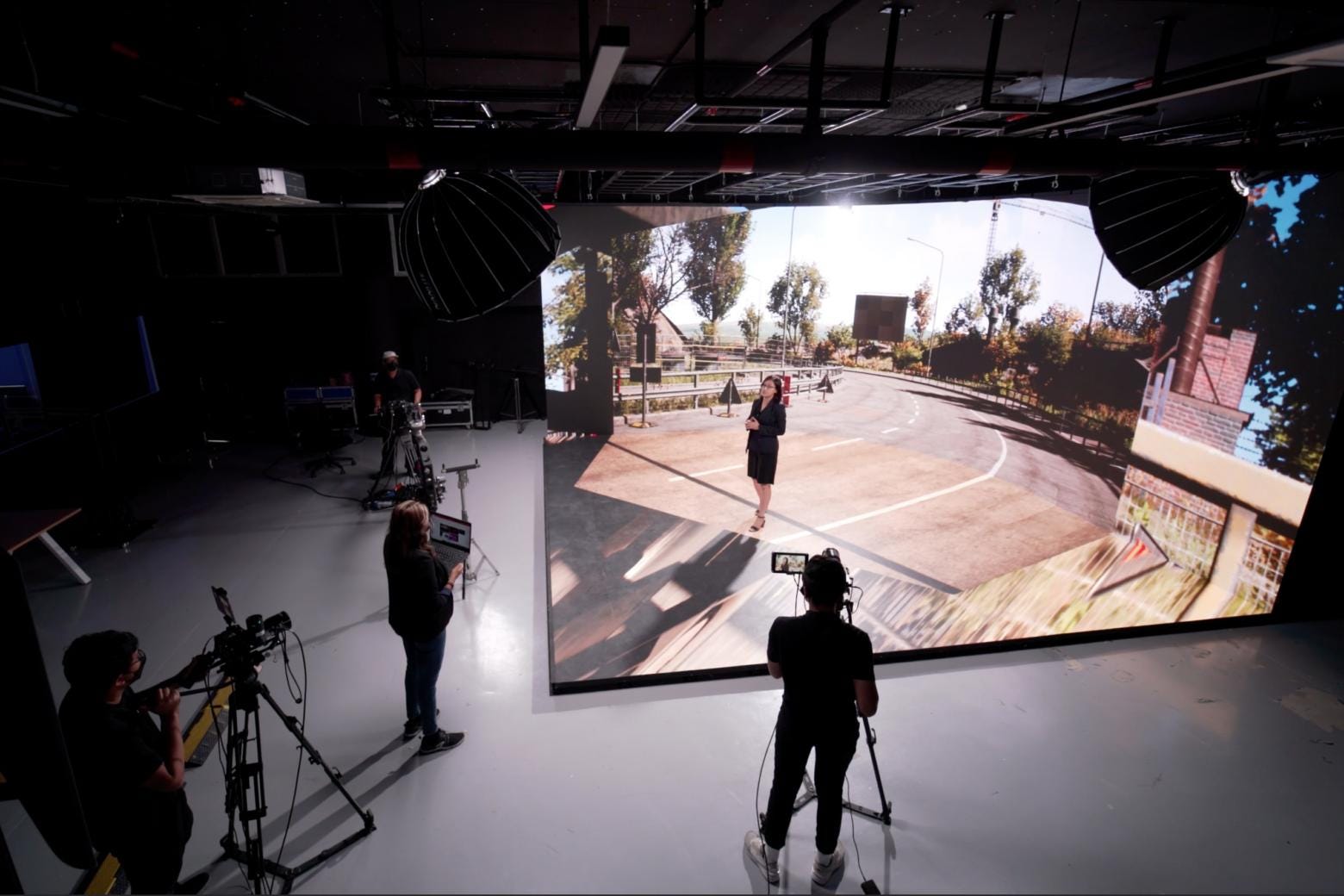
Using Unreal Engine on a volumetric screen produces a much cleaner and more immersive effect than green screen and creates a much broader canvas for local filmmakers to project their vision on to. Without it we are doomed to make kitchen sink dramas about people living in public housing, which isn’t even that interesting because our public housing is clean and safe and good.
I think it is ethical to use AI to generate locations and sets but only a visionary production designer (not to mention costumer designer, hair & makeup artist, prop maker, etc…), can deliver an original look and feel like in Game of Thrones, Mad Men, Peaky Blinders, The Queen’s Gambit, Stranger Things or Sex Education.
So, let’s go back to our list and see what aspects of the filmmaking process might make sense with AI.
AI for research 🟢 Sure, it has access to all the information on earth so go ahead and ask.
AI for conceptualisation 🔴 Chatbots are too sycophantic, they have no taste and no concept of the difference between a good idea or a bad one, let alone an original one. Don’t bother.
AI for screenwriting 🔴 If you want a formulaic screenplay filled with tropes and cliches go for it but I’m guessing that’s not what you want.
AI for storyboarding 🟠 Currently poor consistency and understanding of shot mechanics but, with the right DOP at the helm, it has potential. (https://variety.com/2026/film/news/martin-scorsese-supports-ai-company-storyboard-movies-1236765037/)
AI for production design 🟠 Potentially, if you’re going to be using AI to generate locations and sets then you’re going to want to work with it to make sure it’s possible but, remember, a good production designer is going to get much more out of AI than a novice.
AI for production planning 🔴 Doesn’t work (yet), see above.
AI for performances 🟠 Not now, but maybe soon? (https://variety.com/2026/film/global/ai-actor-tilly-norwood-movie-debut-misaligned-1236802325/)
AI for locations & sets 🟢 If there is no possibility of filming in actual location due to budget or logistics then you have no choice, but this does open up a world of visual opportunities.
AI for editing 🔴 Ha! No. It can barely handle a podcast let alone the complexity of a film. How does it even know what’s a good take?
AI for special effects 🟠 Still not ready but improving fast.
So, is a film that was researched on AI and shot against AI generated backdrops really an AI film? Is the fact that it couldn’t be shot any other way within the borders of Singapore a good enough reason to use AI locations and sets? And can it ever really be ethical considering AI’s epic original sin? It’s been an interesting thought-experiment but ultimately its the customers a.k.a. the audience that will decide.
Backlashes against AI books, music and films, most recently at Tribeca and Tropfest, suggest that at the time of writing the audience has little appetite for dead-eyed androids floating around generic landscapes spouting clichéd lines in service of a hackneyed plot. But as the technology improves and is inevitably taken up by master filmmakers such as Darren Aronofsky, who produced the AI series ‘On This Day…1776’, this will surely change, right? 668 1-star reviews on IMDB and a plethora of scathing reviews suggest not!
So, what do you think - can my friend make an ethical AI film and, if so, would you even watch it? Let me know in the comments below.
To Do List
My recommendations for new things to read, watch, look at, listen to and do this week:
As per usual I took June off to travel, visiting the South of France (35mm pics to follow) and the UK, watching many films in the air so here are my recommendations:
The Housemaid, 5/5
Dear You (Teo Chew version ✊), 4/5
Nuremberg, 4/5
Michael, 4/5
The Drama, 3/5
Bugonia, 3/5
Toy Story 5, 3/5
Scream 7, 2/5
Islands in the Net is a group exhibition bringing together web-based and data-native artworks, archives, and cultural projects to consider Southeast Asian futures in an age shaped by artificial intelligence, data extraction, and memetic culture. It open on Friday 17th July at Singapore Art Museum and I will see you there!
On the 18th of July I’ll be at Room 526 for for Asia’s Big Energy, a Southeast Asian indie showcase headline by local heroes Subsonic Eye supported by Intermission (SG), Texpack (ID), Ministry Of (ID) and Gnaw (SG), get your tickets here: https://www.roomfivetwosix.com/events/asias-big-energy-2026-singapore-chapter
Emergence is a gig featuring the best of new Singaporean rock talent on 23rd July at Hard Rock Cafe including Forests, 10PM Noise Complaint and Taledrops, tickets are only through the Kakee app so I’ll be buying on the door.
And finally, Wheeler’s Estate in Seletar is hosting Punk Poetry 4.0 featuring Shirlyn & The Unexpected playing 3 hours of 90s and 00s punk classics! https://www.eventbrite.sg/e/punk-poetry-40-shirlyn-the-unxpected-tickets-1992334982565
And that will do ya! Cheers, Nx
AI has limitations in imagination and vision and of course emotions.
We are the ones who give colors to the world.
I asked AI to help me with a book draft at first was good but after a while is like you said I was receiving blank sheets for help.
It just helps me with structure but it's better not to ask more than that.
AI belongs nowhere in the filmmaking and artistic process. Disappointing post from a thought leader who brands themself as pro-human. Unsubscribing.