

DEBATE: Is AI the Future of Creativity or The End of Authenticity?
What happened when I went head-to-head with consumer giant Unilever 😱

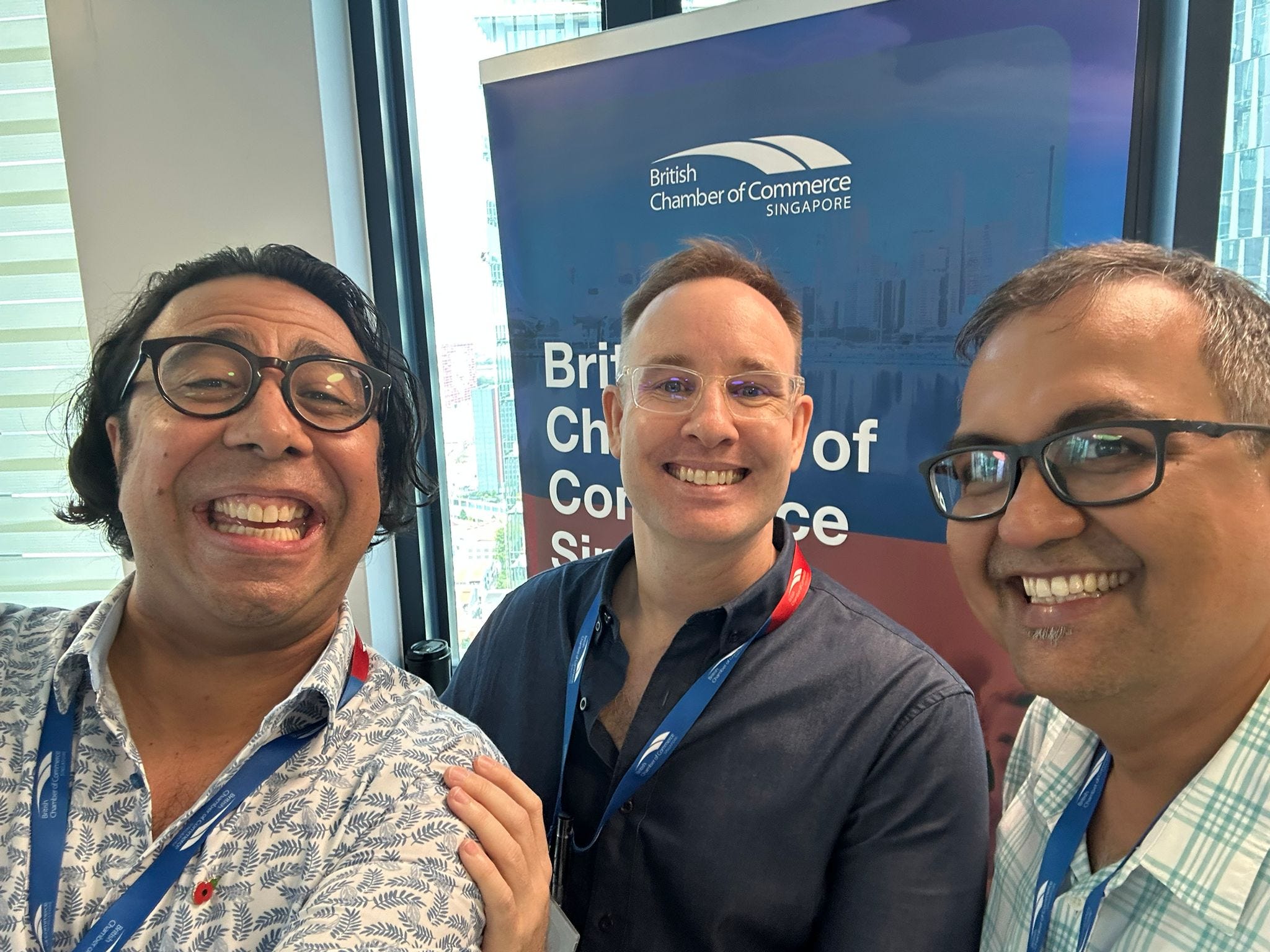
On 4th November last year I took part in a debate for the British Chamber of Commerce in Singapore entitled: Is AI the Future of Creativity or The End of Authenticity?
The audience were made up of members and guests of the Marketing & Communications Committee who came to see me - an independent content and communications consultant - go head-to head-with Madhurjya “Banjo” Banerjee, Senior Global Marketing Director at at FMCG giant Unilever. This is how it went down…
The Debate
The debate was moderated by Andrew Clark, founder of video production agency AsiaWorks and introduced by Andrea Ng of cultural insights company Canvas8, who shared some compelling new research:
While AI use among marketers has exploded (with over 70% using generative tools), consumer trust in brands’ responsible AI use has dropped sharply.
Consumers increasingly detect AI’s “soullessness.” In studies comparing AI and human creative output, AI scores lower on authenticity, emotional appeal, and trust.
People are defining when AI feels acceptable and when human touch is non-negotiable. Forty percent of consumers feel brands “don’t get them as people”, up from 25% a year ago.
After her opening address, which seemed to lean my way, it was my turn to speak for precisely four minutes (listen out for the countdown)…
After me Banjo used his four minutes to argue that every transformative technology, from the printing press to quartz watches, was once seen as the death of artistry. His thesis was that, “AI is not replacing creativity but amplifying it by killing the mundane (and) boosting imagination”. How?
By freeing creators from repetitive tasks (“show me the toothpaste tube at 15 degrees left”) and accelerates ideation.
By allowing ideas to scale and adapt to audiences in new, personalised ways.
By citing Unilever’s use of AI to test hundreds of launch concepts for a toothpaste brand, even discarding a misguided “gorilla with a bright smile” concept before wasting budget on it.
The Response
Following the debate, the audience of about sixty people were split into small groups to tackle one key question each and send a spokesperson back with their answers - see what you think and if you agree:
1. How can AI can genuinely enhance creativity?
Speed seemed to be the main enhancement but whether or not that’s a good thing remained in contention. As the group’s spokesperson said, “With AI you can deliver faster… but at the same time, it’s scary because you’re not using your creative and critical thinking.”
2. Can AI and human creativity co-exist?
The short and unanimous answer to this questions was, “Yes!”. However, the more nuanced version delivered by the spokesperson was, “We can use it for ideas. We can use it for some processing. But before it goes out of the door it has to have that human touch in the same way there’s a human touch for the input.”
3. How should AI creativity be regulated?
This question was answered with a couple of personal experiences; one about buying a series of books from a beloved author only to find out, upon arrival, that they had been written by AI. Another about using AI to check flight times and being served completely wrong information and the ensuing chaos. The conclusion being that there is definitely a need for stronger regulation to prevent these kinds of incidents and, of course, to protect children.
4. Is there a limit to how much we should rely on AI for creative work, and where should we draw the line?
This group took an audience-first approach and had to admit that AI ads, as of now, are not proving popular (Coca-Cola, Vogue, Malaysia Airlines). However, they also pontificated that we are in still in the early stages of the technology and that improvements may yet change audiences minds.
“Either the technology is going to have to get better, and it probably will, or we stop using it and we just use AI for what it is pretty good at right now, which is that back end stuff like finding ways to connect pipes more efficiently, finding ways to produce reports - stuff that people don’t like doing but are needed in the marketing process.”
5. Should the use of AI be declared in creative work?
The spokesperson for this group shared that there were a lot of mixed feelings on the issue but they concluded the following:
“The creative world is probably one of the least necessary areas for (AI) to be declared. But obviously there’s nuances to that. People felt more sensitive when there would be human faces involved or some kind of human representation so, the front cover of Vogue, or if it was a school magazine and you’re generating happy children at school - you’d probably like to know if they were real or not, right?”
The consensus? AI is probably here to stay - but so is the marketer’s responsibility to use it conscientiously.
The Conclusion
I think the most telling moment of the event arrived at the end. Andrew had been using ChatGPT throughout to help him moderate but when he asked the audience if they would like to hear ChatGPT’s conclusions he was met with a loud and resounding “No!” 😂
So, what do you think? Let me know in the comments below.
By the way, I have a brand new short story (just 2,500 words) out on Kindle based on the Pro-Human theme, below:
A Massive Waste of Energy
Dr. Timothy Smith has invented an unlimited source of free, clean energy. All he needs to scale is it is a few investors willing to actually make the world a better place AND make a shit ton of money with it. Sounds like the deal of a lifetime, so why is he having such trouble raising funds? I mean, if YOU had the money and power to end poverty, why wouldn’t you? Another short story set at the end-stage of capitalism about the conflict and confluence between humanity and technology.
Thanks for sharing your experience. If you open LinkedIn, every marketing agency in the world is celebrating A.I. and it makes sense—the incentive structure of marketers aligns with the needs of tech platforms shilling their wares. In any debate it helps to define what you are debating. A.I. is purposely ill-defined because it is a strategy to smooth out the extreme issues with helpful use cases. Moving toothpaste in an image, or editing a background is already a capability in Photoshop—-an actual tool. But generating visual content through prompts is not a benign use of a tool. Defining creativity is like the AGI debate, where we have no clear definition of the human mind, how can we know when silicon has gotten there? Creativity has lost its meaning when our technology has scraped the skin off of every human creative product and then transformed it through an Easy Bake pixel oven into a toxic consumer product. Have we learned nothing from how the internet has extracted attention for its own ends. This is not fear of innovation, this is a demand for tools and technology that actually help humans flourish, not through extractive surveillance capitalism. It’s heartening to see how so far there is resistance to the inauthentic—-we need to push against the inevitability we are being fed.