

Where's all this abundance then?
AI’s been around since the 1950s, Chat GPT since 2022, and around 140,000 US tech workers have lost their jobs since January!

Elon must be off the wagon again. He’s been on The Economist podcast this week (sponsored by Anthropic 😂🤦🏼), talking bollocks about AI, see?
This from the man who also predicted:
An unmanned mission to Mars by 2018 (nope)
Full autonymous Teslas by 2018 (nope)
One million robotaxis on the road by 2020 (nope)
A manned mission to Mars by 2026 (not even close!)
But I want to focus on this particular prediction from the clip above:
“The most likely outcome (of super human intelligence) is an age of amazing abundance where anyone can have anything they can think of, this may sound preposterous but well, here we are in 2026, let’s see where we are in 2036.”
Which he doubles down on just moments later:
“Assuming that there’s not World War 3, I think we’re headed for an age of amazing abundance so this is, I guess, a message of optimism and excitement about the future.”
Musk isn’t the only one saying this of course, all the other men in charge of AI have said something similar and I can see why they might believe it too - they all rank amongst the richest human beings on earth, in fact the richest to have ever lived! But those that work for them may disagree.
According to the Financial Times, nearly 140,000 jobs have been cut from the US tech sector this year with Amazon, Oracle, Meta and Microsoft alone accounting for roughly 50,000 of them. If AI is creating such abundance, how comes the people building it cannot afford to keep their own staff?
Additionally, a global study by the British Standards Institute polling 850 business leaders in Australia, China, France, Germany, Japan, the UK, and the US, found that business leaders have been prioritizing AI automation over training junior employees. 39% said they’d already reduced or cut entry-level roles due to AI and 43% said they expect to do so in 2026. Needless to say, the young people who did everything “right” by taking on student loans and a four year degree only to graduate into an employment wasteland aren’t feeling much abundance right now.
But the real question is not so much whether abundance will arrive but how will it get here and what form is it likely to take?

UBI is already off the table
Early talk was about the introduction of UBI, a Universal Basic Income paid, I assume, by the profits generated by the AI companies except they don’t generate any profits and I have no doubt their accountants will work as hard as Starbucks’ and Amazon’s to ensure they never do.
Money raised is not counted as money earned and therefore is not liable for taxation, just like equity that is owned as opposed to equity that is “realised” cannot be taxed (but can be used as collateral against a loan). What this means is that the companies get funded, the owners get equity - which enables them to borrow vast sums to fund their lifestyles - but the employees pay the bulk of taxes from their earned income and that ain’t nearly enough to cover UBI.
Based on projections from eMarketer, OpenAI is on pace to undershoot its own five-year ad revenue projections by a whopping 90%! Worse than that, eMarketer estimates the entire addressable market for chatbot advertising in the US - the world’s most lucrative ad market - is just $5.4 billion. OpenAI is currently in the hole for $96 billion with $1.4 trillion in spending commitments so where, exactly, will will this taxable profit come from?
Even if OpenAI did, by some miracle, turn a profit one day do you think their shareholders - who collectively own around $630 billion in equity - are going to vote to have their long-awaited returns handed to the taxman to, in turn, hand it to you and me? I think it’s fair to say that UBI is off the table.
What about UBC?
UBC is the new acronym tech leaders are trying to seed into the conversation. It was first mooted by Sam Altman on the ‘All In’ podcast in May 2024 and it stands for Universal Basic Compute i.e. instead of cash he will generously grant you access to AI “compute” for free (or a gov’t subsidised rate), and it will be up to you somehow turn that into wealth, and if you can’t? Well, that’s your problem, we gave you the computing power, what else do you want?
Not only is this a weaselly way out of having to redistribute actual money, gained by stealing the sum of all human knowledge from books, websites and our social media posts, it also shows extreme ignorance of how other people, cultures and economies operate.
To turn “compute” into wealth assumes everyone has the skills, talent, time and inclination to sit in front of a screen all day working out how to do that regardless of whether they already have food on the table or a shelter over their heads, regardless of whether they have received a sufficient education to do so, regardless of whether they have access to electricity or the Internet, regardless of the fact that they may have children or parents to care for at the same time, and regardless of the fact that a farmer cannot grow food with “compute” or without the land and water likely to be requisitioned for the purposes of “compute”.
Universal Basic Compute is clearly a racket whereby, to participate, you’ll have no choice but to buy more tech products and services and allow more data centres to take over the land, water and energy in your communities and even then, if you fail to make yourself a millionaire regardless of your circumstances, that will be your fault because poverty is always painted as a personal moral failing.
AI as a utility?
In March this year ideas man Altman tried out another wheeze in public at the Blackrock Infrastructure Summit, namely, AI as a utility with metered access.
This went down like a cup of cold sick online with many commenters and commentators pointing out that this achieves the complete opposite of abundance and in fact entrenches inequality by making access to intelligence both essential AND dependent on your current income level i.e. the more you can afford to pay, the more you get.
Some of you may recall the ‘Net Neutrality’ protests of 2017 when hundreds of websites went slow to protest ‘pay-as-you-go’ access to the Internet on the grounds that, as a utility, everyone deserved equal access to it at equal speeds. Amazon, Facebook, Google, Spotify and even Y-Combinator, when Altman as President, took a principled stance back then but I wouldn’t count on that happening again.
What does that leave us with?
UBI won’t happen, UBC can’t happen, and AI as a utility might happen but will make the situation far worse, so what other options do we have? Well, if AI is currently only five years away from being smarter than the smartest human (🙄), then surely it should have an answer to this fairly simple question, right? Which is why I asked ChatGPT Pro:
What is the most likely and achievable way to redistribute the gains of AI to create “abundance” for the maximum number of people now and in the near future?
And this is what it told me:
The most practical answer: an AI social dividend, not an immediate full UBI
The most likely and achievable route is to capture part of the capital income and economic rents created by AI, distribute some of it immediately through existing tax and benefit systems, and invest the remainder in a permanent citizens’ wealth fund.
That would combine:
a modest dividend for everyone;
larger income top-ups and transition support for people most affected;
better and cheaper essential services;
broader public and employee ownership of the productive capital generating the gains.
It is more realistic than attempting to calculate how many “robots” a company has, and more affordable in the near term than paying everyone a full living income.
Download the full answer below if you’re curious but be warned it was entirely generated by ChatGPT Pro with no further editing or input from me:

There you have it! From the mouth of Sam Altman’s own babe. A PhD level answer, according to him, which means we can all start receiving abundance tomorrow. What’s wrong with that? Surely it’s not “hallucinating” is it?
The fact is, we already have enough wealth on earth to create abundance for everyone but we/they/society choose not to. That should tell you all you need to know about how this is going to play out. AI will create unfathomable abundance for thee but not for you or for me.
My advice to my 11-year-old daughter? If you don’t want to live your life as a slave to the screen or the tech oligarchs, if you want to live free and make independent choices, if you want to feel empowered and make an actual contribution to society, hone a skill that cannot be replicated by a machine. She adores animals my kid, so I am encouraging her to spend as much time exploring that as possible because ten years from now the world will still need vets, groomers, even dog-walkers and even it doesn’t, because Skynet has taken over, at least I’ll have clothes and meat to sell you - but I don’t take “compute”!

To Do List
My recommendations for new things to read, watch, look at, listen to and do this week:
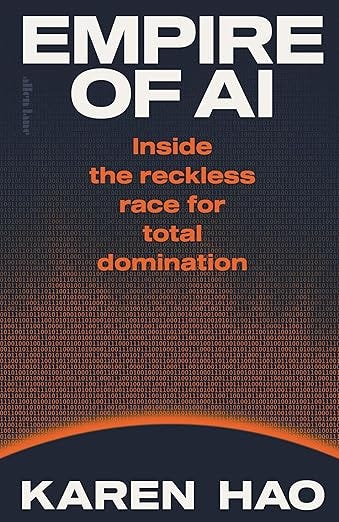
READ: I was reluctant to attempt Karen Hao’s ‘Empire of AI’ simply on the grounds that it is very thick with very small print BUT I have raced through the first 150 pages and can confirm it is something of a page turner so give it a go.
ATTEND: Tomorrow night I’ll be at ‘AI & Actors: Now What?’ presented by The Actor’s Society as a discussion about the realities, risks, and possibilities of AI in our industry. It’s free but you must RSVP HERE.
ATTEND: AI in the arts is clearly a hot topic because VICPA (The Visual, Audio, Creative Content Professionals Association - catchy!), is putting on its 5th Annual Creatives Night with the theme ‘Staying human in an AI world’, featuring the boys behind ‘Yah Lah But…’, actor/writer Nicole Lee Wen and more. Get your tickets here: https://www.eventbrite.sg/e/vicpa-creatives-night-tickets-1993425701936
ATTEND: British shoegazers Slowdive are back in town on on Saturday 12th December to play Fort Canning Park: https://lamcpresents.com/slowdive-live-in-singapore/
Right, that’ll do ya! Cheers, Nx